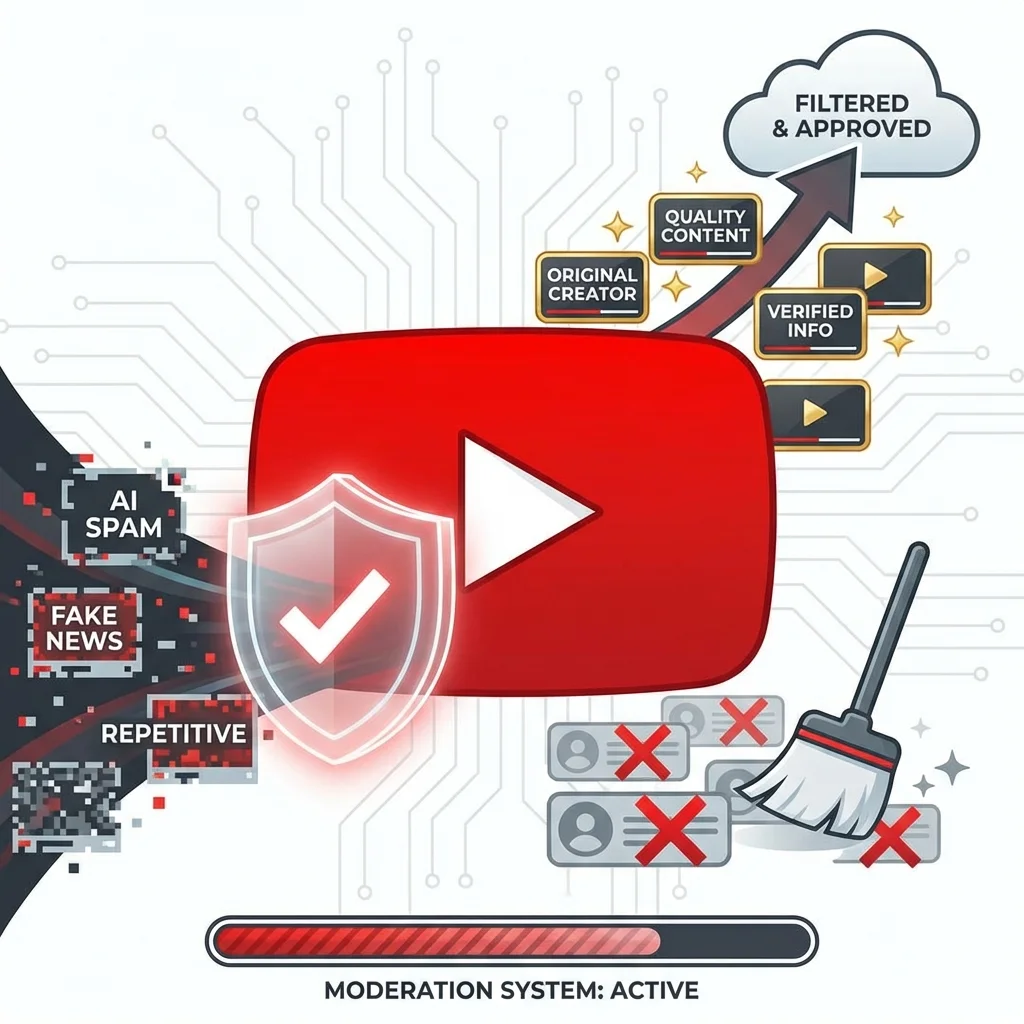
AI TL;DR
YouTube removed 16 major AI spam channels with 4.7 billion views. CEO Neal Mohan calls fighting 'AI slop' a 2026 priority. Here's what creators need to know.
YouTube's AI Slop Crackdown: What Creators Must Know in 2026
YouTube has declared war on low-quality AI-generated content. In January 2026, the platform executed its largest-ever removal of AI spam channels, signaling a major shift in content moderation strategy that every creator needs to understand.
The Numbers: A Historic Takedown
In early 2026, YouTube removed 16 of the top 100 most-subscribed AI spam channels in a single coordinated enforcement action:
- 4.7 billion total views wiped from the platform
- 35 million combined subscribers lost access to channels
- ~$9.78 million in estimated annual advertising revenue eliminated
- Over 50,000 videos removed in the initial sweep
This wasn't just routine content moderation—it was a statement. YouTube CEO Neal Mohan personally announced that combating "AI slop" would be a top priority for 2026, dedicating new resources to detection and enforcement.
What Exactly Is "AI Slop"?
The term "AI slop" refers to low-effort, mass-produced content that exploits AI tools to generate high volumes of videos with minimal human creativity or value. Here's what characterizes this type of content:
| Characteristic | What It Looks Like | Why It's Problematic |
|---|---|---|
| Repetitive footage | AI-generated landscapes or stock imagery on infinite loops | Provides no unique value to viewers |
| Synthetic voices | Text-to-speech narration reading stolen or scraped scripts | Lacks authenticity and often violates copyright |
| Clickbait thumbnails | AI-generated shocking or misleading imagery | Manipulates viewers into clicking |
| High upload volume | 10-50+ videos published per day | Floods the algorithm, crowding out authentic creators |
| Template-based | Same video structure with different topics | Indicates automated production |
The key distinction: legitimate AI-assisted content adds human creativity, insight, and value. AI slop is purely automated content farming designed to game the algorithm for ad revenue.
Major Channels Removed
YouTube's enforcement action targeted some surprisingly large channels. Here are some of the most notable removals:
| Channel | Subscribers | Total Views | Action Taken |
|---|---|---|---|
| CuentosFascinantes | 5.2M | 890M | Fully terminated |
| ImperioDeJesus | 3.8M | 720M | Fully terminated |
| AIStoryTime | 4.5M | 1.1B | All videos wiped |
| BrainrotJourney | 2.1M | 340M | Demonetized permanently |
| HistoryMystery AI | 1.8M | 290M | Terminated |
| SuperfactsFun | 3.1M | 580M | Videos wiped |
Many of these channels operated in non-English languages, taking advantage of less scrutinized markets. The enforcement sends a clear message: AI spam farms will be identified regardless of language or regional focus.
How YouTube Detects AI Slop
YouTube has deployed a multi-layered detection system that combines AI analysis with human review. Here's what powers the detection engine:
1. Upload Pattern Analysis
The system flags accounts that upload at inhuman frequencies or maintain rigid scheduling patterns that suggest automation. A human creator typically uploads 1-3 videos per week; AI farms might upload 10+ per day.
2. Content Fingerprinting
Advanced algorithms compare visual and audio elements across millions of videos, identifying recycled footage, common AI-generated image styles, and synthetic voice signatures.
3. Engagement Signal Analysis
AI slop typically shows unusual engagement patterns:
- Extremely low comment-to-view ratios
- High bounce rates (viewers leaving quickly)
- Minimal sharing or playlist additions
- Subscriber counts that don't match view patterns
4. AI Watermark Detection
YouTube now scans for C2PA and SynthID watermarks that major AI tools embed in generated content. Lack of required disclosure triggers additional review.
New Disclosure Rules (February 2026)
YouTube implemented stricter disclosure requirements for AI-generated content starting February 2026:
| Content Type | Disclosure Required? | Penalty for Non-Compliance |
|---|---|---|
| AI-generated video footage | ✅ Yes, mandatory | Video removal |
| AI-generated or cloned voice | ✅ Yes, mandatory | Demonetization |
| AI-assisted editing/effects | 🔄 Recommended | Warning |
| AI-generated thumbnails | ❌ Not required | None |
| AI background music | ✅ Yes, if fully synthetic | Demonetization |
Escalating penalties for violations:
- First offense: Warning and required disclosure addition
- Second offense: Video removal
- Third offense: Channel demonetization
- Pattern of violations: Permanent termination
What's Still Allowed (And Encouraged)
Not all AI use is problematic. YouTube has clarified that these practices remain fully acceptable:
- ✅ AI-assisted editing: Using AI to color grade, stabilize, or enhance footage
- ✅ AI music: Generating background tracks with proper disclosure
- ✅ Creative AI animation: Using tools like Runway or Sora for artistic projects
- ✅ AI research help: Using ChatGPT or Claude to research topics
- ✅ AI thumbnails: Creating eye-catching images (disclosure not required)
- ✅ AI transcription: Auto-generating captions and translations
What's explicitly not allowed:
- ❌ Fully automated content farms
- ❌ Undisclosed synthetic voices impersonating real people
- ❌ Mass-produced templated videos
- ❌ AI-generated misinformation or deepfakes
Key Takeaways for Creators
If you're a creator using AI tools—or worried about being mistakenly flagged—here's your action plan:
1. Disclose AI Use Clearly
Use YouTube's built-in disclosure tools. It's better to over-disclose than risk penalties. The platform rewards transparency.
2. Add Genuine Human Value
The difference between AI slop and legitimate AI-assisted content is human contribution. Add your unique perspective, research, analysis, or storytelling that couldn't be automated.
3. Prioritize Quality Over Quantity
Resist the temptation to use AI for volume. One thoughtful, well-produced video outperforms dozens of shallow automated ones—both algorithmically and for long-term audience building.
4. Report Obvious Slop
Help clean up the platform by reporting AI spam when you encounter it. YouTube's enforcement team uses community reports to identify patterns.
5. Stay Updated on Policies
YouTube's AI policies are evolving rapidly. Subscribe to the Creator Insider channel and check the YouTube Help center monthly for updates.
The Bigger Picture
YouTube's crackdown reflects a broader industry reckoning with AI-generated content. As generative AI makes content creation trivially easy, platforms must distinguish between tools that enhance human creativity and systems that replace it entirely.
The message is clear: AI should be a tool, not a replacement for creative intent. Channels that use AI to amplify genuine human value will thrive. Those that treat it as a shortcut to ad revenue will be eliminated.
For legitimate creators, this is ultimately good news. A cleaner platform means authentic content can surface more easily, and viewer trust in the creator ecosystem improves.
Related reading: