AI TL;DR
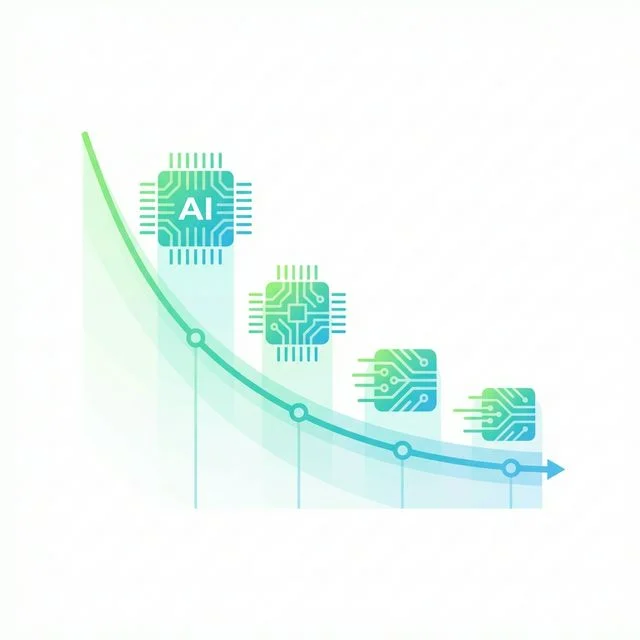
AI inference costs dropped 90% in 18 months. Open-source models match proprietary ones. The price collapse is reshaping the entire industry—here's what it means for you.
Why AI Models Are Getting Cheaper Faster Than Anyone Predicted
In early 2024, a GPT-4-class query cost roughly $0.03 for input and $0.06 for output per 1,000 tokens. In February 2026, equivalent performance is available for less than $0.001. That's a 90%+ price collapse in under two years.
This isn't a gradual decline. It's a price freefall—and it's changing everything about how AI businesses work, how developers build, and how consumers benefit.
The Numbers
| Model Class | Cost per 1M Input Tokens (Early 2024) | Cost per 1M Input Tokens (Feb 2026) | Decline |
|---|---|---|---|
| Frontier proprietary | $30+ (GPT-4) | $2-15 | 50-90% |
| Mid-tier proprietary | $10-15 | $0.50-3 | 80-95% |
| Open-source equivalent | $5-10 (hosted) | $0.10-0.50 | 95%+ |
| Self-hosted open-source | N/A | Near-zero (compute only) | — |
Why It's Happening
1. Open-Source Competition
DeepSeek, Zhipu (GLM-5), MiniMax, Meta's Llama, and Mistral are releasing models that match or approach frontier performance—for free. When the commodity is freely available, proprietary pricing collapses.
2. Hardware Getting Better
- NVIDIA's newer GPU generations improve performance-per-watt
- AMD and custom chips create hardware competition
- Specialized inference chips (Groq, Cerebras) dramatically reduce per-query costs
- Quantization techniques allow models to run on cheaper hardware
3. Algorithmic Efficiency
- Mixture of Experts (MoE): Only activates relevant model portions per query
- Speculative decoding: Generates tokens faster with smaller draft models
- KV cache optimization: Reduces memory costs for long conversations
- Model distillation: Transfers knowledge from large models to smaller, cheaper ones
4. Scale Economics
As AI usage grows from millions to billions of daily queries, infrastructure costs per query decrease. Fixed costs (data centers, research) are amortized across more users.
Winners and Losers
Winners
Developers and Startups: Building AI-powered products is now radically cheaper. A startup can offer AI features that would have cost $100,000/month in API fees two years ago for under $5,000/month.
Consumers: More AI features in more products at lower prices. Free tiers are more generous. Paid tiers offer more.
Open-Source Community: Their models are driving the price collapse, gaining influence and adoption.
Infrastructure Providers: Cloud providers, chip makers, and hosting companies benefit from increased volume even as per-unit prices drop.
Losers
Proprietary Model Companies: OpenAI, Anthropic, and Google face margin pressure. Their moats are shrinking as open-source catches up.
AI Wrappers: Companies that added a thin layer on top of GPT-4 and charged a premium are being squeezed. If the underlying model is cheap, the wrapper needs to add significant value.
Overvalued AI Startups: Companies valued on the assumption of sustained high API margins may face corrections.
What This Means Practically
For Businesses
- AI features become table stakes: Every SaaS product will have AI. It's no longer a differentiator—it's expected.
- Build vs. buy calculus changes: Self-hosting open-source models becomes economically viable for more companies.
- Experimentation is cheap: Test AI features without worrying about API costs. Iterate freely.
For Developers
- Multi-model strategies: Route queries to the cheapest model that can handle them effectively.
- Open-source first: Start with open-source models. Upgrade to proprietary only when necessary.
- Fine-tuning becomes practical: Creating specialized models for specific tasks is now affordable.
For Consumers
- Free tiers improve: As costs drop, companies can offer more generous free access.
- AI becomes invisible: More products integrate AI seamlessly without charging extra.
- Quality floor rises: Even "budget" AI is now quite good.
The Prediction
By end of 2027:
- Frontier model inference will cost 10x less than today
- Open-source models will be indistinguishable from proprietary for most tasks
- The competitive advantage will shift entirely to application layer (UX, data, integration)
- AI will be as commoditized as cloud computing—essential infrastructure, not a product
The Bottom Line
The AI price collapse is the most important trend in tech right now, and most people aren't paying enough attention to it. It's making AI accessible to everyone, reshaping business models, and shifting the competitive landscape from "who has the best model" to "who builds the best product with AI."
If you've been hesitating to integrate AI because of costs—stop hesitating. The prices will only go down from here.