AI TL;DR
NVIDIA's CES 2026 announcements mark the 'ChatGPT moment for robotics' with Cosmos world models and Isaac GR00T N1.6. Here's everything you need to know about physical AI.
Physical AI in 2026: NVIDIA Cosmos, Humanoid Robots & The ChatGPT Moment for Robotics
At CES 2026, NVIDIA CEO Jensen Huang declared what many in the industry had been anticipating: we've reached the "ChatGPT moment for robotics."
Just as ChatGPT democratized access to language AI, NVIDIA's new suite of physical AI tools promises to do the same for intelligent machines that can see, reason, and interact with the real world.
Let's break down everything announced and what it means for the future of robotics.
What Is Physical AI?
Physical AI refers to artificial intelligence systems designed to understand and interact with the physical world—not just process text or images, but actually control robots, autonomous vehicles, and smart devices that operate in real environments.
Unlike traditional AI that lives purely in software, physical AI must:
- Understand physics: Gravity, friction, spatial relationships
- Predict outcomes: What happens if I push this object?
- Plan actions: Step-by-step sequences to achieve goals
- Adapt in real-time: React to unexpected changes
NVIDIA's CES 2026 announcements target each of these challenges with a comprehensive ecosystem of tools.
NVIDIA Cosmos World Models
The centerpiece of NVIDIA's physical AI push is the Cosmos family of world models—AI systems that can understand, simulate, and predict physical environments.
Cosmos Transfer 2.5 & Cosmos Predict 2.5
These open, customizable models serve two critical functions:
| Model | Function | Key Capability |
|---|---|---|
| Cosmos Transfer 2.5 | Synthetic Data Generation | Converts 3D simulation inputs into high-fidelity video for training |
| Cosmos Predict 2.5 | Future State Prediction | Generates up to 30 seconds of video predicting what happens next |
Why this matters: Training robots in the real world is slow, expensive, and potentially dangerous. Cosmos models allow developers to generate millions of realistic training scenarios in simulation before ever deploying a physical robot.
Cosmos Reason 2
The third component is Cosmos Reason 2, a visual language model (VLM) specifically designed for:
- Physical reasoning: Understanding how objects interact
- Spatio-temporal understanding: Tracking objects through time
- Long-context processing: Up to 256K tokens for complex scenarios
- Object detection: 2D/3D point localization and trajectory prediction
Available in 2B and 8B parameter sizes, Cosmos Reason 2 gives robots the ability to think logically about their environment—not just react to it.
Isaac GR00T N1.6: The Robot Foundation Model
If Cosmos is the world model, Isaac GR00T N1.6 is the brain that controls the robot itself.
What Makes GR00T N1.6 Special
GR00T N1.6 is a Vision-Language-Action (VLA) model that processes:
- Visual input from cameras
- Language instructions from humans
- Robot state information (joint positions, balance, etc.)
And outputs precise motor commands for smooth, human-like movement.
Key Technical Advances
| Feature | GR00T N1.5 | GR00T N1.6 |
|---|---|---|
| Diffusion Transformer Layers | 16 | 32 |
| Action Prediction | Absolute | State-relative |
| Movement Quality | Good | Human-like fluidity |
| Reasoning Engine | Basic | Cosmos Reason 2 integration |
The switch to state-relative action prediction is particularly significant. Instead of commanding "move joint to 45 degrees," N1.6 commands "move joint 5 degrees from current position." This results in:
- More natural movements
- Better balance on uneven terrain
- Smoother recovery from disturbances
Dual-System Cognitive Architecture
Inspired by human cognition research, GR00T N1.6 implements a dual-system architecture:
- System 1 (Fast Thinking): Reflexive motor control at 30Hz for immediate reactions
- System 2 (Slow Thinking): High-level planning using Cosmos Reason 2 for complex decision-making
This mirrors how humans operate—we don't consciously think about every muscle movement while walking, but we do plan our route.
Supporting Infrastructure
NVIDIA didn't just release models—they built an entire ecosystem.
Isaac Lab-Arena
A new standardized framework for evaluating robot performance in simulation. Think of it as the "ImageNet" for robotics—a common benchmark that allows researchers to compare results across different systems.
OSMO Cloud Orchestration
A cloud-native tool that unifies:
- Training workflows
- Simulation management
- Deployment pipelines
- Model versioning
This addresses one of the biggest pain points in robotics: the fragmented toolchain that slows development.
Jetson T4000 Module
New edge computing hardware based on the Blackwell architecture, offering:
- 4x better energy efficiency than previous generation
- On-device AI inference for robots
- Designed for the NVIDIA Jetson Thor robotics computer
Real-World Applications
NVIDIA demonstrated several practical applications at CES 2026:
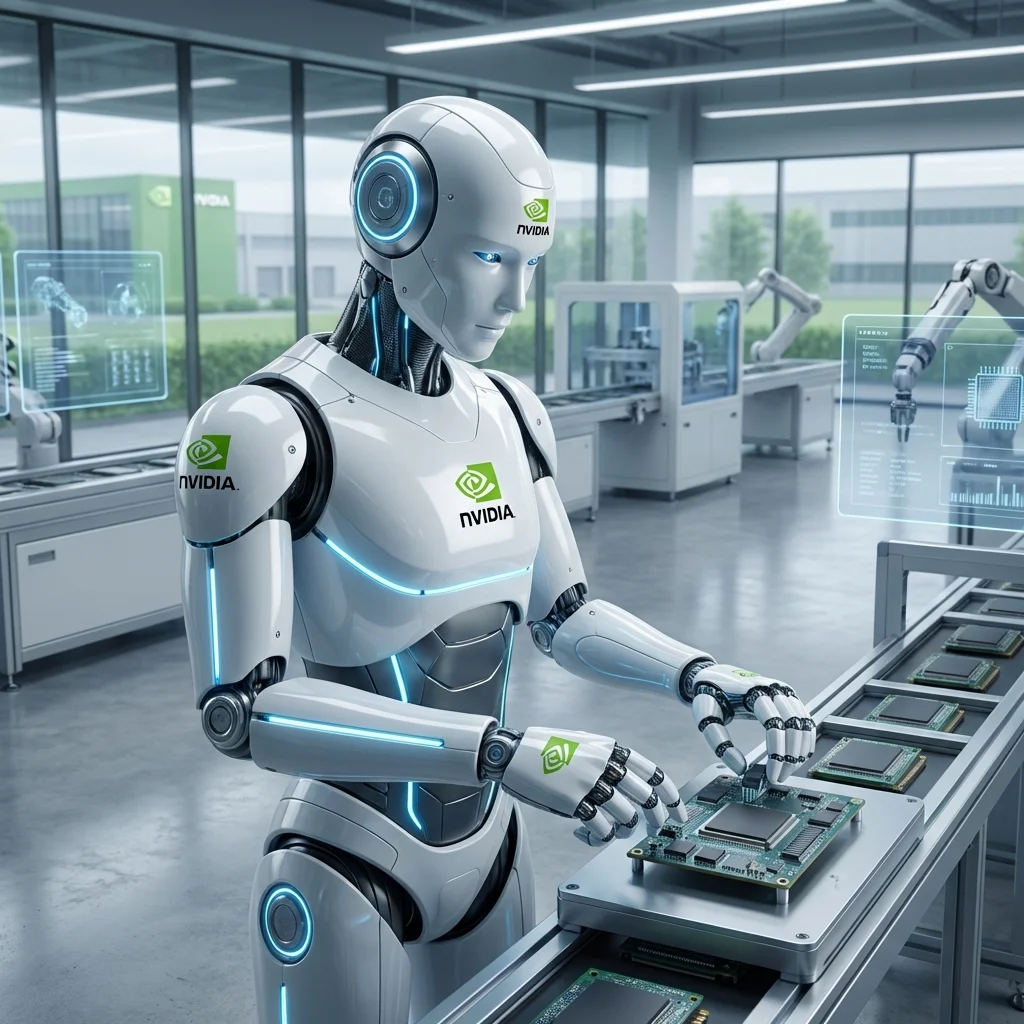
Manufacturing
Humanoid robots performing:
- Precision assembly tasks
- Quality inspection
- Material handling
- Collaborative work alongside humans
Healthcare
Assistive robots for:
- Patient mobility support
- Medication delivery
- Rehabilitation exercises
- Elder care assistance
Logistics
Warehouse automation including:
- Package sorting
- Inventory management
- Last-mile delivery preparation
Industry Partnerships
NVIDIA collaborated with key players to accelerate adoption:
Hugging Face Integration
All new models are available through Hugging Face and integrated with the LeRobot open-source framework. This dramatically lowers the barrier to entry—developers can now:
- Download pre-trained models
- Fine-tune on their specific robot
- Deploy without building from scratch
Robot Manufacturer Adoption
Several humanoid robot companies are already integrating GR00T N1.6:
- Figure AI - General-purpose humanoid robots
- Apptronik - Apollo humanoid platform
- 1X Technologies - NEO humanoid robot
- Agility Robotics - Digit warehouse robot
What This Means for the Future
Jensen Huang's prediction: "Thinking machines will work alongside humans in factories within 3-5 years."
Here's the timeline he outlined:
| Timeframe | Milestone |
|---|---|
| 2026 | Foundation models enable rapid prototyping |
| 2027 | First commercial deployments in controlled environments |
| 2028 | Widespread factory adoption begins |
| 2029-2030 | Collaborative human-robot workforces become standard |
The Democratization Effect
Just as GPT models made language AI accessible to any developer, NVIDIA's physical AI stack aims to do the same for robotics:
- Before: Building a capable humanoid robot required tens of millions in R&D
- After: Download open models, fine-tune on your hardware, deploy
This doesn't mean everyone will build robots overnight—but it dramatically reduces the expertise and capital required to enter the field.
Getting Started with Physical AI
For developers interested in exploring NVIDIA's physical AI ecosystem:
1. Explore Cosmos Models
# Available on Hugging Face
pip install transformers
# Search for nvidia/cosmos models
2. Set Up Isaac Sim
NVIDIA Isaac Sim provides a complete simulation environment for testing robot behaviors before real-world deployment.
3. Join the Community
- NVIDIA Developer Forums: Official support and discussions
- Hugging Face LeRobot: Open-source robot learning community
- ROS 2: Robot Operating System integration
The Bottom Line
CES 2026 marked a turning point for robotics. NVIDIA's comprehensive physical AI ecosystem—from Cosmos world models to GR00T foundation models to edge computing hardware—provides the building blocks for the next generation of intelligent machines.
Whether you're a robotics researcher, a manufacturing company exploring automation, or just someone curious about where AI is heading, physical AI is the space to watch in 2026 and beyond.
The "ChatGPT moment for robotics" has arrived. The question is: what will you build with it?
Related articles: