AI TL;DR
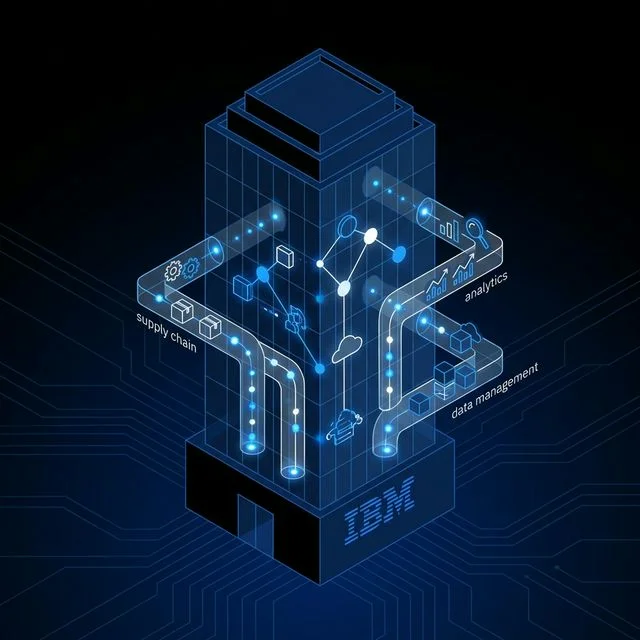
IBM is embedding AI agents across its entire software portfolio—from supply chain to analytics. If your company runs IBM, here's what's coming in Q1 2026 and how to prepare.
IBM's Enterprise Agentic AI Rollout: What Your Business Needs to Know
While the AI world obsesses over consumer chatbots, IBM just made the most significant enterprise AI move of 2026: they're embedding agentic AI agents across their entire software portfolio. Not as add-ons. Not as optional features. As core functionality built directly into the platforms businesses already use.
If your organization runs IBM products—integration, analytics, messaging, supply chain—this affects you right now.
What IBM Is Doing
IBM is delivering new agentic AI capabilities across six major product areas, with planned availability in Q1 2026:
| Product Area | AI Agent Capabilities |
|---|---|
| Integration (IBM App Connect) | Self-healing integrations, automatic error resolution |
| Analytics (IBM Cognos, Watson) | Autonomous data analysis, insight generation |
| Data Management (Db2, DataStage) | AI-driven data quality, automated pipelines |
| Engineering (IBM Engineering) | Intelligent requirements tracing, impact analysis |
| Messaging (IBM MQ) | Predictive queue management, auto-scaling |
| Supply Chain (IBM Sterling) | Autonomous order management, demand sensing |
This isn't building a separate "AI product" and hoping enterprise customers adopt it. This is putting AI agents inside the tools people already use every day.
How Enterprise AI Agents Work
Not a Chatbot—A Coworker
Traditional AI in enterprise: "Ask a question, get an answer."
IBM's agentic approach: "I noticed an integration failure, diagnosed the root cause, implemented a fix, and notified the team—all before anyone opened a support ticket."
The Agent Architecture
Business Process → Monitoring Agent
                        ↓
                  Issue Detected?
                   ↓          ↓
                  Yes         No → Continue monitoring
                   ↓
              Diagnosis Agent
                   ↓
              Resolution Agent
                   ↓
            Human Approval (if needed)
                   ↓
              Action Executed
                   ↓
              Log & Learn
Each agent type has a specific role:
- Monitoring Agents: Watch for anomalies and potential issues
- Diagnosis Agents: Analyze root causes using historical data
- Resolution Agents: Implement fixes within predefined parameters
- Escalation Agents: Route complex issues to the right humans
Department-by-Department Impact
IT Operations
Before: Integration breaks at 2 AM → alert fires → on-call engineer wakes up → investigates for an hour → applies fix → documents incident.
After: Integration breaks at 2 AM → AI agent detects failure → diagnoses issue (e.g., schema mismatch) → applies automated fix → restarts flow → logs resolution → sends morning summary.
Impact: 70-80% reduction in mean time to resolution for common integration failures.
Data Teams
Before: Data quality issues discovered during monthly reviews → manual investigation → root cause analysis → pipeline fixes → reprocessing.
After: AI agents continuously monitor data quality → detect anomalies in real-time → trace issues to source → suggest or auto-apply corrections → maintain audit trail.
Impact: Shift from reactive to proactive data quality management.
Supply Chain
Before: Demand spikes cause stockouts → manual reordering → supplier communication → expedited shipping costs.
After: AI agents sense demand signals → adjust forecasts in real-time → auto-generate purchase orders → negotiate with supplier APIs → optimize shipping routes.
Impact: Reduced stockouts, lower expedited shipping costs, improved demand accuracy.
Analytics
Before: Business users request reports → analysts build dashboards → stakeholders review → ask follow-up questions → another round of analysis.
After: AI agents proactively surface insights → generate narrative explanations → highlight anomalies → suggest actions → track outcomes of implemented recommendations.
Impact: Faster time-to-insight with less analyst bottleneck.
What Makes IBM's Approach Different
1. Embedded, Not Bolted-On
Other vendors offer AI as a separate product you integrate. IBM is putting agents directly into existing products. No new tool to learn, no new interface to adopt.
2. Enterprise-Grade Governance
IBM's agents come with:
- Audit trails for every agent action
- Role-based access to agent capabilities
- Compliance logging for regulated industries
- Explainability: Every decision can be traced and explained
3. watsonx Foundation
The agents run on IBM's watsonx platform, which provides:
- Enterprise-grade AI models
- Data lakehouse for context
- AI governance tools
- OpenShift deployment flexibility
4. Gradual Autonomy
IBM's approach features a trust-building model:
- Advisory mode: Agent suggests actions, human approves
- Supervised mode: Agent acts but human reviews
- Autonomous mode: Agent acts independently within guardrails
- Full autonomy: Agent manages entire workflows (rare, high-trust scenarios)
Implementation Guide for IT Leaders
Phase 1: Assessment (Weeks 1-4)
- Inventory your IBM product portfolio and versions
- Identify highest-impact processes for agent automation
- Map current pain points (integration failures, data quality issues, supply chain bottlenecks)
- Evaluate which product updates include agentic capabilities
Phase 2: Pilot (Weeks 5-12)
- Select one product area for initial deployment
- Start in advisory mode—let agents suggest, humans approve
- Measure impact on resolution time, accuracy, and productivity
- Build confidence in agent recommendations
Phase 3: Scale (Months 3-6)
- Expand to additional product areas
- Increase autonomy for proven, low-risk agent actions
- Integrate agents across product boundaries
- Train teams on human-agent collaboration
Phase 4: Optimize (Ongoing)
- Monitor agent performance metrics
- Refine guardrails based on experience
- Explore cross-functional agent orchestration
- Share best practices across teams
Challenges to Prepare For
Change Management
People are used to being the ones who fix problems. Having AI agents handle routine issues requires cultural adjustment. Frame it as "freeing up time for higher-value work" rather than "replacing what you do."
Data Quality Prerequisites
Agents are only as good as the data they work with. Before deploying agentic capabilities, ensure:
- Data pipelines are reliable
- Historical incident data is clean
- Monitoring baselines are established
Governance Overhead
Initially, governance requirements (audit trails, approvals, compliance checks) may slow things down. This is temporary—governance frameworks mature as confidence builds.
The Bottom Line
IBM's enterprise AI agent rollout is the most pragmatic approach to agentic AI we've seen in 2026. Rather than building flashy demos, they're embedding agents into the tools enterprises already use, with the governance and gradual autonomy that regulated industries demand.
If you're running IBM products, the transition to agentic capabilities is happening whether you plan for it or not. The organizations that prepare early—piloting agents, training teams, building trust—will capture the benefits fastest.
This is what enterprise AI adoption actually looks like: not revolutionary overnight, but transformatively powerful over quarters.