AI TL;DR
Fujitsu's new AI-Driven Software Development Platform, powered by the Takane LLM, completed a 3-month project in 4 hours during a proof of concept. Here's how it works.
Fujitsu's AI Dev Platform Claims 100x Productivity: What 3 Months of Work in 4 Hours Looks Like
100x productivity. That's not a typo, and it's not marketing fluff—at least, not entirely. Fujitsu just unveiled an AI-Driven Software Development Platform that automates the entire software development lifecycle, from requirements definition to integration testing. And they have a proof of concept to back up the claim.
Let's look at what happened, how it works, and whether this changes the game for enterprise software development.
The Proof of Concept That Turned Heads
Fujitsu demonstrated the platform on a real-world task: updating medical fee revision software for the Japanese healthcare system.
| Metric | Traditional Method | Fujitsu AI Platform |
|---|---|---|
| Time to complete | 3 person-months | ~4 hours |
| Productivity multiplier | 1x | ~100x |
| Task scope | Full update cycle | Full update cycle |
This wasn't a toy demo. Medical fee revision software must comply with strict regulatory requirements, handle complex business logic, and integrate with existing healthcare systems. The fact that Fujitsu chose this as their proof of concept—rather than something simpler—lends credibility to the claim.
How the Platform Works
The Takane LLM
At the core is Takane, Fujitsu's proprietary large language model developed in collaboration with Cohere Inc. The model specializes in:
- Enterprise applications and business logic understanding
- Japanese language proficiency (critical for Japanese regulatory software)
- Code generation across enterprise tech stacks
- Requirements comprehension from natural language specs
Multi-Agent Architecture
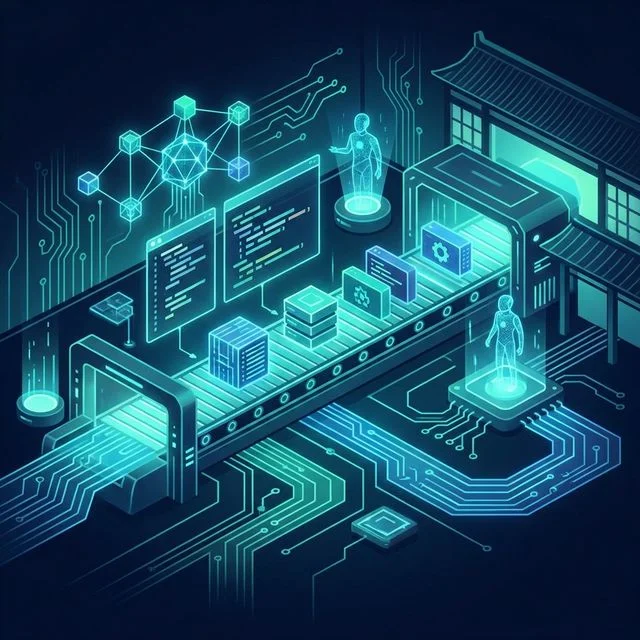
The platform uses multiple AI agents that handle different phases of the SDLC:
- Requirements Agent: Interprets natural language requirements and regulatory specifications
- Design Agent: Translates requirements into technical architecture and design documents
- Implementation Agent: Generates production code based on design specifications
- Testing Agent: Creates and runs integration tests automatically
These agents work sequentially but autonomously, passing artifacts from one phase to the next—similar to how a human development team operates, but at machine speed.
Full SDLC Coverage
| Phase | What the AI Does |
|---|---|
| Requirements Definition | Parses regulatory text, identifies change requirements |
| Design | Creates system and detailed design documents |
| Implementation | Generates code changes and modifications |
| Integration Testing | Writes and executes test cases |
This is a significant departure from AI coding assistants like GitHub Copilot or Cursor, which primarily assist with the implementation phase. Fujitsu's platform tackles the entire pipeline.
How This Compares to Existing AI Coding Tools
| Feature | Fujitsu AI Platform | GitHub Copilot | Cursor | OpenAI Codex |
|---|---|---|---|---|
| Requirements → Code | ✅ Full pipeline | ❌ Code only | ❌ Code only | Partial |
| Auto testing | ✅ Integration tests | ❌ | ❌ | ❌ |
| Enterprise focus | ✅ Regulated industries | General | General | General |
| Multi-agent | ✅ Specialized agents | ❌ Single model | ❌ Single model | ✅ Agent-based |
| Self-contained | ✅ End-to-end | ❌ Assistant | ❌ Assistant | Partial |
Fujitsu's Rollout Plan
Phase 1: Internal Deployment (Now–FY2026)
Fujitsu is using the platform internally to update all 67 types of medical and government business software products offered by Fujitsu Japan Limited. These updates are driven by legal and regulatory changes—the perfect use case for AI that can understand requirements and implement systematic changes.
Phase 2: Global Launch (FY2026+)
The platform will be offered as a pay-as-you-go service globally starting as early as fiscal year 2026. Target industries include:
- Finance: Regulatory compliance updates
- Manufacturing: Quality management systems
- Retail: Inventory and pricing systems
- Public Services: Government software modernization
The Reality Check
What's Genuinely Impressive
- End-to-end automation: Most AI coding tools assist; this one executes
- Regulatory understanding: The PoC involved complex legal requirements, not simple CRUD apps
- Measurable results: 3 months → 4 hours is a concrete, verifiable claim
- Production-ready output: The code is being used in real medical software
What Remains Uncertain
- Generalizability: The PoC focused on a specific type of systematic code update (regulatory revisions). Can it handle greenfield development? Novel architectures?
- Quality: The 100x speed is meaningful only if code quality is comparable. We need more data on bug rates and maintenance costs
- Complexity ceiling: How does it perform on architecturally complex systems with many interdependencies?
- Language/framework scope: How well does it work outside Japanese enterprise tech stacks?
Why This Matters for the Industry
The Shift from "AI Assistant" to "AI Developer"
Fujitsu's platform represents a philosophical shift:
- Current tools (Copilot, Cursor): AI helps the developer write code
- Fujitsu's approach: AI handles the development process; humans define what needs to be built
This is the agentic AI approach applied to software development—not a smarter autocomplete, but an autonomous development team.
Enterprise Software Is the Perfect Target
Enterprise software maintenance is largely systematic:
- Regulatory compliance updates
- API version migrations
- Security patches across codebases
- Data model changes propagated through layers
These are exactly the kinds of tasks where AI can achieve dramatic speedups—predictable patterns, well-documented requirements, and clear success criteria.
Who Should Watch This
- Enterprise CTOs managing large legacy codebases
- Government IT departments dealing with regulatory software
- Consulting firms that handle systematic code updates
- QA teams interested in automated integration testing
- Anyone who estimates projects in person-months for regulatory updates
The Bottom Line
Fujitsu's 100x productivity claim is attention-grabbing, but the important detail is the context. This isn't 100x for building a new social media platform from scratch. It's 100x for systematic, requirements-driven updates to enterprise software—which is where a huge portion of enterprise IT spending actually goes.
If the global rollout delivers similar results across industries and tech stacks, this platform could fundamentally change how enterprise software maintenance is budgeted and executed. The pay-as-you-go model makes it accessible, and the multi-agent architecture makes it architecturally sound.
This is one to watch closely.