AI TL;DR
The EU AI Act's major deadlines hit in August 2026. Here's the complete timeline for high-risk AI, transparency rules, and compliance requirements. This article explores key trends in AI, offering actionable insights and prompts to enhance your workflow. Read on to master these new tools.
The Most Important AI Law in History
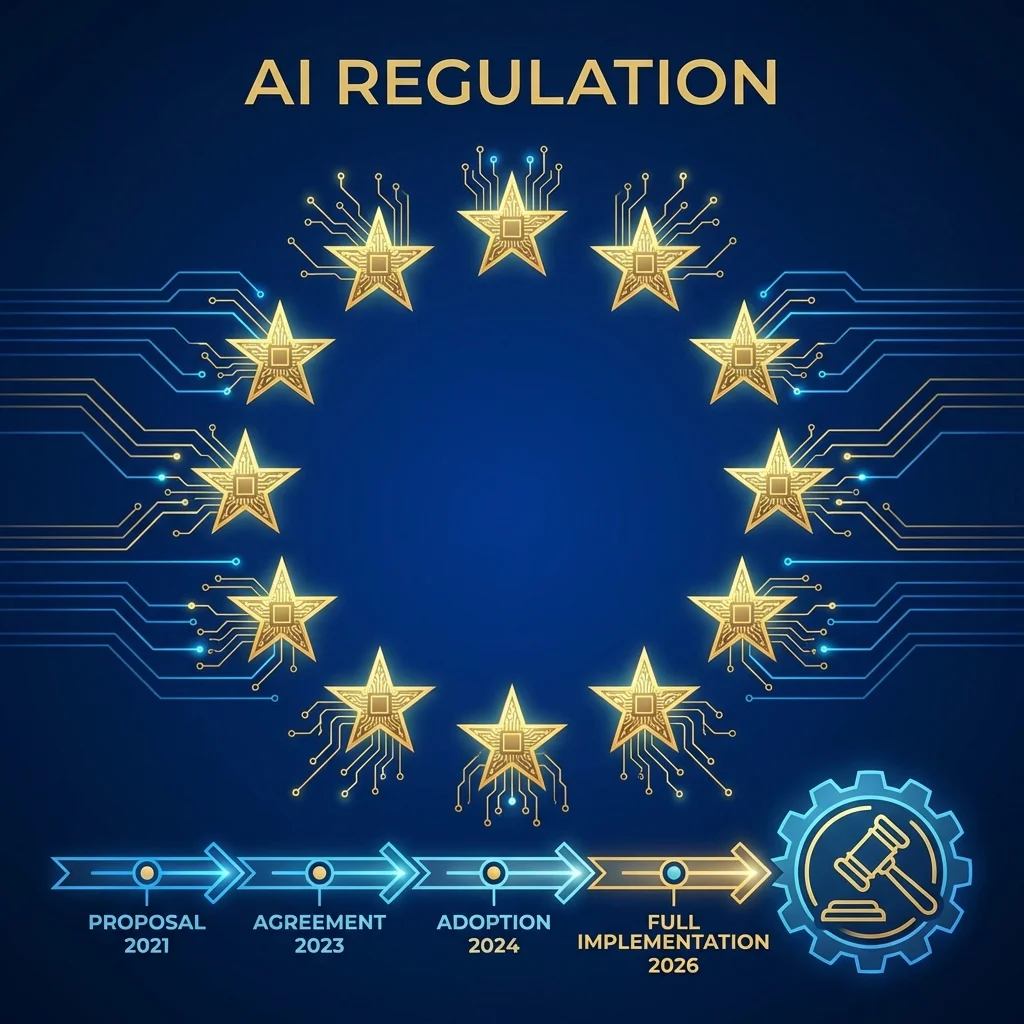
The EU AI Act is the world's first comprehensive AI regulation, and 2026 is when the rubber meets the road. While the law entered into force on August 1, 2024, most of its major provisions become enforceable in August 2026.
If you develop, deploy, or use AI systems in Europe, this timeline is essential reading.
The Complete EU AI Act Timeline
Already in Effect
| Date | What Became Applicable |
|---|---|
| August 1, 2024 | EU AI Act entered into force |
| February 2, 2025 | Prohibited AI practices banned |
| February 2, 2025 | AI literacy obligations began |
| August 2, 2025 | GPAI (General-Purpose AI) governance rules |
| August 2, 2025 | Obligations for foundation model providers |
Coming in 2026
| Date | What Becomes Applicable |
|---|---|
| August 2, 2026 | High-risk AI system requirements |
| August 2, 2026 | Transparency duties for AI systems |
| August 2, 2026 | Full enforcement begins for most operators |
| August 2, 2026 | AI regulatory sandboxes required in each Member State |
Extended Transition (2027)
| Date | What Applies |
|---|---|
| August 2, 2027 | High-risk AI in regulated products (medical devices, machinery, etc.) |
| August 2, 2027 | Final deadline for full compliance |
Understanding High-Risk AI
The August 2026 deadline centers on high-risk AI systems. But what counts as high-risk?
High-Risk Categories
The EU AI Act designates AI systems as high-risk if they're used in:
| Category | Examples |
|---|---|
| Biometric identification | Facial recognition, voice ID |
| Critical infrastructure | Energy, water, traffic management |
| Education | AI grading, admission decisions |
| Employment | Resume screening, performance evaluation |
| Essential services | Credit scoring, insurance pricing |
| Law enforcement | Predictive policing, evidence analysis |
| Migration & border | Visa processing, interview analysis |
| Justice & democracy | Legal research AI, voting systems |
What High-Risk AI Providers Must Do
Starting August 2, 2026, providers of high-risk AI systems must:
- Risk Management: Implement continuous risk assessment systems
- Data Governance: Ensure training data quality and representativeness
- Technical Documentation: Maintain detailed records of AI development
- Record Keeping: Log AI system activities for audit purposes
- Transparency: Provide clear information to users
- Human Oversight: Enable meaningful human control
- Accuracy & Robustness: Ensure reliable performance
- Cybersecurity: Protect against vulnerabilities
The Guidance Gap Problem
There's a challenge: the European Commission missed its February 2, 2026 deadline to issue guidance on classifying high-risk AI systems.
What This Means
- Uncertainty about which AI systems qualify as high-risk
- Businesses struggling to prepare without clear rules
- Industry groups calling for enforcement delays
The Digital Omnibus Package
Brussels has suggested potentially delaying high-risk obligations under its "Digital Omnibus package," citing:
- Unfinished technical standards
- Need for legal clarity
- Industry readiness concerns
However, as of now, the August 2, 2026 deadline remains official.
Transparency Requirements
Beyond high-risk AI, transparency duties affect a broader range of AI systems.
What's Required
| AI Type | Transparency Requirement |
|---|---|
| Chatbots | Must disclose users are interacting with AI |
| Emotion detection | Must inform subjects of processing |
| Deepfakes | Must label AI-generated content |
| AI content | Must be identifiable as AI-generated |
General-Purpose AI (GPAI) Rules
Already applicable since August 2025, but worth reviewing:
For All GPAI Providers
- Technical documentation requirements
- Copyright law compliance
- Summary of training data
For Systemic Risk GPAI (like GPT-5, Gemini 3)
- Model evaluation and adversarial testing
- Incident monitoring and reporting
- Cybersecurity protections
- Energy consumption reporting
AI Regulatory Sandboxes
By August 2, 2026, each EU Member State must establish at least one AI regulatory sandbox.
What Are Sandboxes?
Controlled environments where:
- Innovative AI can be developed and tested
- Regulators provide guidance and oversight
- Companies get clarity before full market launch
Benefits
- Reduced compliance risk for innovators
- Faster time to market for safe AI
- Better regulatory understanding of emerging tech
Penalties for Non-Compliance
The EU AI Act includes significant fines:
| Violation | Maximum Fine |
|---|---|
| Prohibited AI practices | €35 million or 7% global revenue |
| High-risk AI violations | €15 million or 3% global revenue |
| Incorrect information to authorities | €7.5 million or 1.5% global revenue |
For SMEs, fines are calculated proportionally.
Preparing for August 2026
Immediate Actions
- Audit your AI systems: Identify which qualify as high-risk
- Document everything: Start building technical documentation now
- Assess training data: Ensure data governance is in place
- Train your team: AI literacy is already required
Before August 2026
- Implement risk management: Establish continuous assessment processes
- Enable human oversight: Design for meaningful human control
- Prepare for audits: Have records ready for regulatory review
- Update user disclosures: Ensure transparency requirements are met
Who Does This Apply To?
Geographic Scope
The EU AI Act applies to:
- Companies based in the EU
- Companies outside the EU whose AI affects EU users
- Providers (developers) of AI systems
- Deployers (users) of AI systems
- Importers and distributors
Practical Impact
If you sell or use AI that impacts anyone in the EU, you likely need to comply.
Key Dates to Remember
| Date | Action Item |
|---|---|
| Now | Ensure AI literacy and no prohibited practices |
| Now | GPAI providers should be compliant |
| August 2, 2026 | High-risk AI systems must comply |
| August 2, 2026 | Transparency requirements enforced |
| August 2, 2027 | High-risk AI in regulated products deadline |
What's Different About the EU AI Act?
Risk-Based Approach
Unlike broad AI laws, the EU AI Act focuses on risk levels:
- Unacceptable risk: Banned outright
- High risk: Heavy regulation
- Limited risk: Transparency only
- Minimal risk: Self-regulation
Technology-Neutral
The law regulates how AI is used, not specific technologies. This means:
- Applies to current and future AI
- No need to update for new tech
- Focus on outcomes, not methods
Conclusion
The EU AI Act's August 2026 deadline is approaching fast. While there's uncertainty around guidance and potential delays, the safest assumption is that high-risk AI requirements will be enforced as scheduled.
Organizations using AI in Europe should:
- Start compliance work now
- Monitor guidance updates closely
- Consider regulatory sandbox participation
- Prepare documentation and governance frameworks
The EU AI Act represents a new era of AI regulation. Companies that prepare early will have competitive advantages, while those caught unprepared face significant fines and market access issues.
Sources: European Commission, Europa.eu, EU AI Act official documentation, February 2026